Table of Contents
- The Spatial Flaws of Traditional Property Lists
- Organizing Portfolios by Neighborhood and Territory
- Elevating Buyer User Experience with Micro-Interactions
- Hyper-Local SEO and Capturing Regional Buyer Intent
- Conclusion
1. The Spatial Flaws of Traditional Property Lists

The Missing Context Dilemma
The real estate market is fundamentally defined by location, yet countless property websites still present their listings through outdated, text-heavy directories or simple chronological grids. Forcing prospective buyers to scroll through endless rows of text blocks and street addresses strips away the most critical context of any property: its relationship to the surrounding neighborhood. When house hunters cannot immediately visualize where a home sits relative to local schools, transit routes, or city borders, they face immediate browsing fatigue and often abandon the site for a competitor.
The Drop-Off Effect
Standard, linear text rows fail to convey true location value, resulting in tedious pagination and endless scrolling. This friction causes house hunters to bounce away quickly, lowering your site's dwell time and reducing the visibility of your ad inventory. A dynamic map solves this by providing a high-value, engaging tool that keeps users on the page and dramatically extends user session lengths, instantly showing them how properties connect to the amenities that matter most.
2. Organizing Portfolios by Neighborhood and Territory
Zoning Visual Clarity
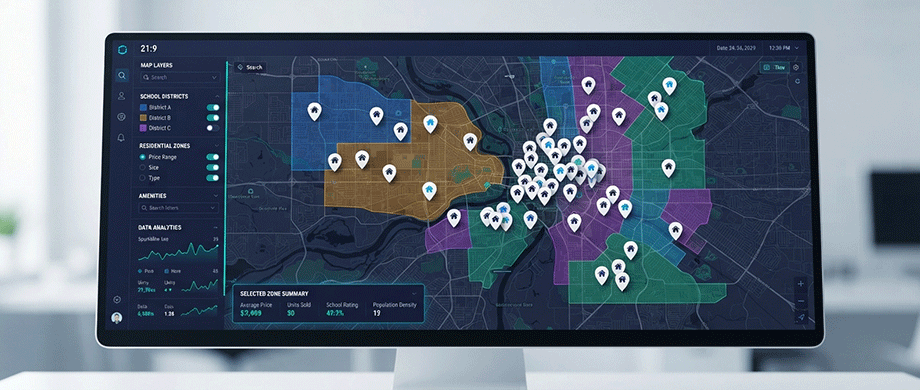
One of the most powerful features of an interactive map is the ability to visually categorize properties by neighborhood, school district, or commercial zone. By applying distinct colors to different territories, you allow buyers to instantly grasp the layout of a city at a single glance. This is particularly effective for highlighting safe residential pockets, premium school catchment areas, or vibrant commercial hubs, transforming a confusing list of addresses into an intuitive, color-coded discovery tool.
Frictionless Discovery
Interactive maps enable buyers to view localized clusters of homes across specific territories effortlessly. Instead of manually filtering through pages to see what's available in a given area, users can simply pan and zoom to their preferred neighborhood to see all active listings displayed as pins. This self-guided discovery process empowers house hunters to evaluate local markets on their own terms, making your real estate website an indispensable planning utility.
3. Elevating Buyer User Experience with Micro-Interactions

Dynamic Property Tooltips
Passive text listings cannot compete with the rich engagement offered by interactive map micro-interactions. By using an interactive map plugin, you can configure map pins to reveal critical property details instantly upon hover or click. Imagine a buyer hovering over a location pin and seeing a tooltip pop up with high-resolution thumbnail photos, price fields, and bedroom counts immediately. This instant feedback loop satisfies curiosity and keeps users deeply engaged with your content.
Self-Guided Market Tours
Instead of passively scrolling through static galleries, you let users pan and zoom through communities to evaluate local amenities on their own terms. This shift to a proactive exploration mindset gamifies the property hunt and keeps readers glued to the page to click on individual markers and explore hidden gems. By encouraging users to uncover your best localized recommendations on their own, you dramatically increase pageview durations without inducing reading fatigue.
4. Hyper-Local SEO and Capturing Regional Buyer Intent

Ranking for Location-Specific Queries
Search engine optimization in the real estate niche requires targeting niche keywords with high transaction intent. While ranking on the first page for broad terms like "homes for sale" is incredibly difficult due to competition from massive corporate sites, capturing long-tail, neighborhood-specific search queries (such as "condos for sale in South Beach Miami" or "homes near top-rated schools in Austin") is highly achievable. By embedding custom interactive maps, you give search engine crawlers explicit proof that your site provides highly specific, valuable answers to these detailed queries, helping your listings rank higher for the terms that serious buyers are actually using.
Building Regional Topical Authority
To build lasting topical authority that search engines trust, your real estate website needs a strong, logical internal linking architecture. Interactive maps function as a visual directory that organizes your individual articles or property pages into structured, easy-to-navigate content clusters:
- Eliminating Dead Ends: Connect your primary map markers directly to deeper, single-property blog posts or community review articles across your domain, ensuring that no detailed sub-page gets left unlinked.
- Distributing Ranking Equity: High-traffic pillar articles pass authority down to newer, specialized neighborhood guides through these contextual map links, speeding up how quickly search engine crawlers find and index your new posts.
- Contextual Anchor Signals: Using city and attraction names as the clickable links on your map pins passes highly accurate, descriptive context to search algorithms regarding your target location content.
Conclusion: Fuel Real Estate Growth with Interactive Visuals
To build a highly profitable real estate website that captures high-intent buyers and earns premium ad revenue, you have to transition away from passive, static text directories. The modern property hunter expects more than just a list of addresses; they demand a dynamic tool that helps them visualize the neighborhood, understand spatial relationships, and explore communities on their own terms. Implementing interactive maps gives your audience a valuable planning tool that transforms your portfolio from a boring flat directory into an immersive spatial discovery hub.
By strategically organizing your listings with color-coded neighborhood boundaries, embedding high-converting property details inside dynamic tooltips, and structuring your pages for seamless ad placements, you build an efficient framework designed for long-term growth and high conversions. Interactive maps don't just delight your users—they dramatically extend session lengths, lower bounce rates, and provide clear proof to search engines that your site delivers genuine utility.
Furthermore, by capturing hyper-local, long-tail search queries and distributing ranking equity across your content clusters, you establish lasting topical authority that drives consistent organic traffic. When you pair this SEO strength with clean, strategic ad positioning around your interactive mapping assets, you maximize your RPM and create a monetization engine that scales alongside your growing portfolio.
If you are ready to give your audience a professional, fast, and fully responsive property discovery experience, discover how our premium Interactive Map WordPress Plugins can elevate your real estate website monetization today!

About the Author
Botrous Kerolos has been designing and building interactive maps for the web since 2009 — from early Flash/SWF maps to modern SVG — and leads development at WP Map Plugins, helping WordPress sites turn static content into fast, accessible, interactive experiences.